
Your free resource is on its way to your inbox!
BUT FIRST: Check your inbox and confirm your email.
What’s next?
After you confirm your email, you’ll get your free resource.
Check your SPAM folder if you don’t see it.
And check out the deal below! You don’t want to miss out on this great resource: 46 conversation-starting prompts that go deeper than 'how was your day'".
🎉 BEFORE YOU GO! 🎉
You've got the freebie. Maybe you've even tried "the magic question." And somewhere in the back of your mind you're thinking: okay, but now what?
Here's the honest answer: connection with your teen doesn't happen because you finally found the right question. It happens because you keep showing up with curiosity instead of control, over and over, in the small moments, until they believe you mean it.
This workbook is your "keep showing up" tool.
You already know the drill
"How was your day?" Fine. "What's going on with you lately?" Nothing. "We need to talk." (door closes)
It's not that your teen doesn't have anything going on. It's that talking to a parent, directly, face-to-face, about the real stuff? That's terrifying at 15. So they say "fine" and disappear into their room, and you're left standing in the hallway wondering when exactly you became someone they don't tell things to.
You didn't do anything wrong. This is just what adolescence does — it makes teens pull inward right when they need connection the most. Your job isn't to force the door open. It's to make it safe enough that they open it themselves.
What this actually is
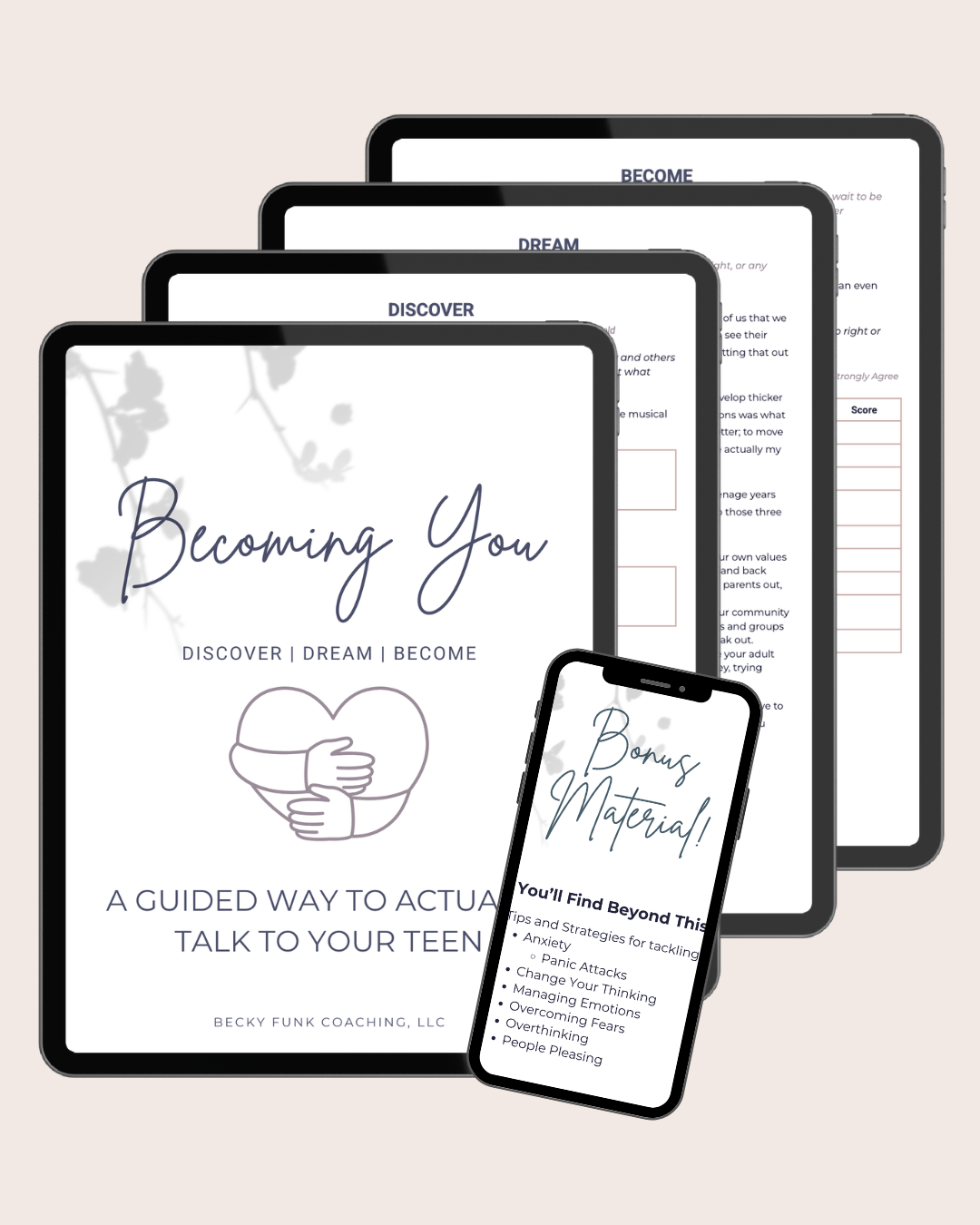
I originally built this workbook for the teens I coached directly, 46 pages of the exact questions and exercises I used to help them figure out who they are (separate from what everyone else told them), work through anxiety and overthinking, and build real confidence.
Here's what I learned, though: it barely ever worked as a "do this on your own" assignment. It worked when someone sat next to them. Asked the questions out loud. Went first.
So that someone is going to be you.
What's inside
Discover — favorites, strengths, values, the words that actually describe them (not the ones that got stuck to them)
Dream — who they're becoming, in three areas that shape the rest of their life: identity, belonging, and purpose
Become — a fixed vs. growth mindset assessment, and a step-by-step process for turning "I want to change" into actually doing it
Bonus toolkit — anxiety and panic attack tools, an emotion wheel for naming big feelings, a "change your thinking" exercise for negative self-talk, and sections on overthinking, people-pleasing, and fear
Plus two new sections written just for this version:
A mom-facing intro that reframes the whole workbook as something you do with your teen, not something you hand off
How to Use This With Your Teen — four real ways to bring it into your relationship, whether that's a sit-down conversation or one question dropped into a car ride
How it works
You won't finish this in a weekend, and that's the point. Pull one page. One car-ride question. One "random thing I was thinking about" over dinner. Some weeks you'll get real conversation. Other weeks, one-word answers. Both are progress.
The goal was never to complete the workbook. The goal is that your teen starts to believe, one question at a time, that you're a safe place to bring the real stuff.
Get instant access for only $20
(Compare that to a single coffee run and a movie ticket — for a tool you'll use for years, not one Tuesday afternoon.)
Instant PDF download and option to use it as a Google doc. Print it, use it digitally, come back to it as many times as you need.
"But will my teen actually do this?"
Probably not alone, and that's exactly why this version exists. You're not handing them a worksheet. You're bringing the questions to them, on your terms, in the moments that already work for your relationship. That's a very different ask than "go fill this out."
"I'm not really a 'workbook' person."
Neither am I, honestly. Skip around. Use it out of order. Half the value is just having 46 pages of good questions on hand for whenever the moment's right. You don't have to be a journaling person to use it that way.
Once you've spent some time in these pages, you'll probably start noticing where the real friction points are with your teen — which is exactly what we dig into next in Understand Your Teen, where I map out both of your personalities and give you a real plan for minimizing the clashes.
But that's a conversation for later. Right now, go get the questions that get your teen talking.